Principles

People Identify Objects by Recognizing Patterns
Principle 3 of 100Chapter 1: How we see

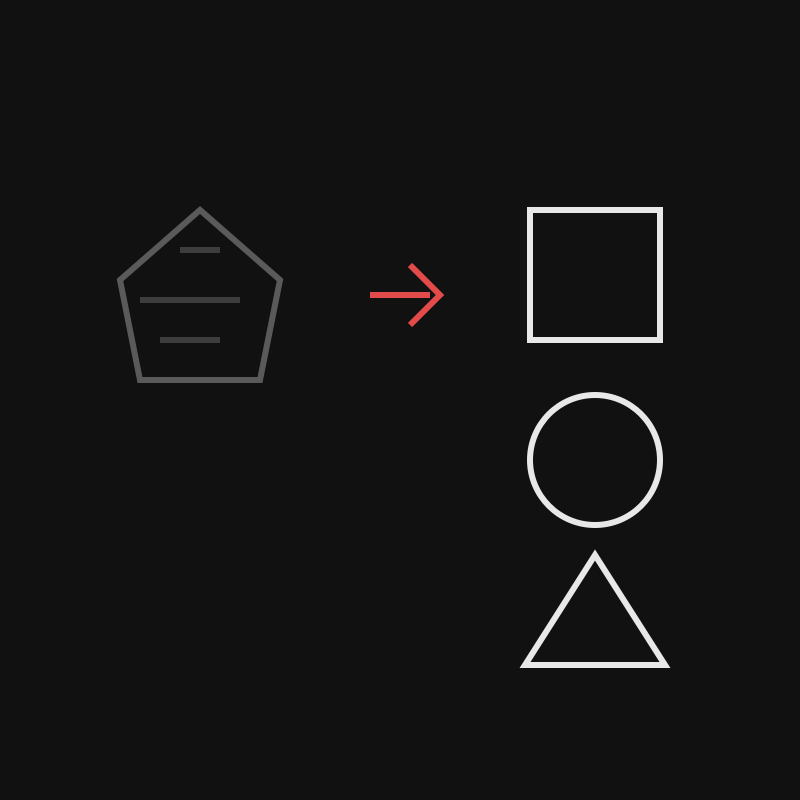
The brain doesn't analyze what it sees from scratch every time. It looks for familiar patterns to take a shortcut. Among the simplest are basic geometric shapes: it breaks what it sees down into them, then puts them back together to recognize it.

That's why a simple icon is understood faster than a decorated one. Every extra detail, a shadow, a gradient, inner lines, adds something to break down before recognition. The effect grows as the icon gets smaller, because small details turn into noise.

The space around an icon is part of its shape. Icons packed together merge into one block; the gap between them is what separates them.

What I built

A navigation bar in two versions. On top, colorful three-dimensional icons with shadows, details and badges, so the eye has to take them apart before it recognizes them. Below, line icons built from simple geometric shapes with equal spacing between them, so each icon reads at first glance. The labels are the same in both: Home, Explore, Library, Favorites and Account.

References

All principles

39 of 100

1How we see

  1. 1What You See Isn't What Your Brain Gets
  2. 2Peripheral Vision Does More Than Central Vision to Get the Gist
  3. 3People Identify Objects by Recognizing Patterns
  4. 4There's a Special Part of the Brain Just for Faces
  5. 5There's a Special Part of the Brain for Simple Visual Features
  6. 6People Scan Screens Based on Past Experience and Expectations
  7. 7People See Cues That Tell Them How to Interact With Things
  8. 8People Can Miss Changes in Their Field of View
  9. 9People Believe Things That Are Close Together Belong Together
  10. 10Red and Blue Together Are Hard on the Eyes
  11. 119% of Men and Half a Percent of Women Are Color-Blind
  12. 12Colors Mean Different Things in Different Cultures

2How we read

  1. 13It's a Myth That Capital Letters Are Inherently Hard to Read
  2. 14Reading and Comprehension Are Two Different Things
  3. 15Pattern Recognition Helps People Identify Letters in Different Fonts
  4. 16Font Size Matters
  5. 17Reading on a Screen Is Harder Than Reading on Paper
  6. 18People Read Faster With Longer Lines, but They Prefer Shorter Ones

3How we remember

  1. 19Short-Term Memory Is Limited
  2. 20We Can Only Remember Four Items at a Time
  3. 21Information Sticks Only When It's Used
  4. 22Recognizing Information Is Easier Than Recalling It
  5. 23Remembering Takes a Lot of Mental Resources
  6. 24Memories Are Reconstructed Each Time They're Recalled
  7. 25Forgetting Is a Natural Part of How Memory Works
  8. 26Vivid Memories Aren't Always Accurate

4How we think

  1. 27People Process Information Better in Bite-Sized Chunks
  2. 28Some Types of Mental Processing Are More Challenging Than Others
  3. 29The Mind Wanders a Third of the Time
  4. 30The More Uncertain People Are, the More They Defend Their Ideas
  5. 31People Create Mental Models
  6. 32The Interface Shapes the Conceptual Model
  7. 33People Process Information Best in Story Form
  8. 34People Learn Best From Examples
  9. 35People Are Driven to Create Categories
  10. 36Time Is Relative
  11. 37People Ignore Information That Doesn't Fit Their Beliefs
  12. 38People Can Get Into a Flow State
  13. 39Mixed Text in Arabic Interfaces

1 of 1