People Can Get Into a Flow State
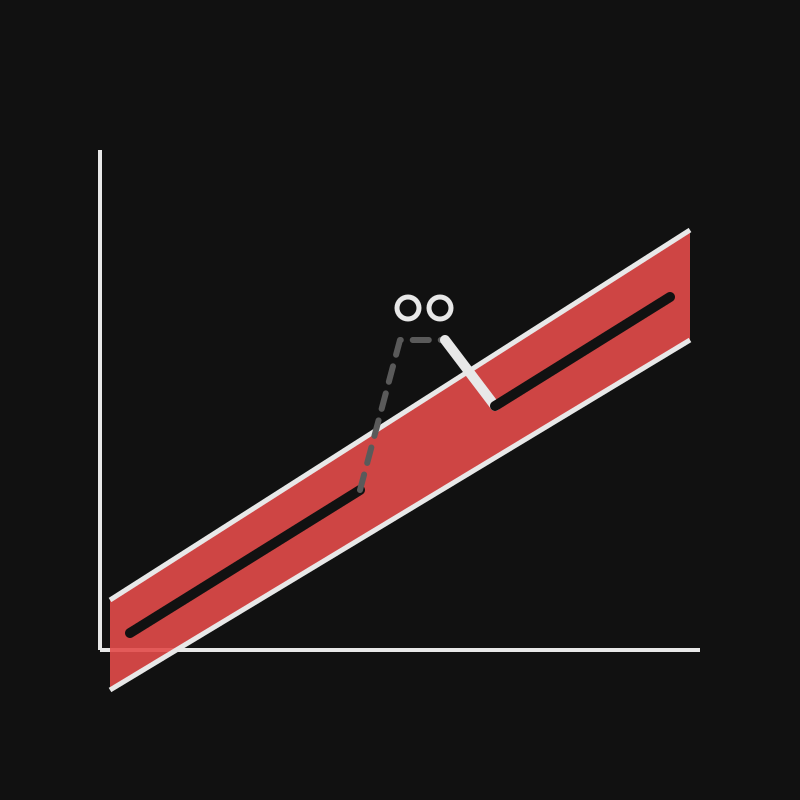
Flow is a state where we're so absorbed in an activity that everything around us fades. It doesn't happen by chance, but when the challenge matches our skill: easier than our ability and we get bored, harder and we get frustrated. And this balance shifts during the activity itself, so what fit a minute ago can become too hard after a single stumble.
The recitation session
The screen is from a Quran memorization app I helped design. In a recitation session the page is hidden and the user recites, and the correct verse is highlighted green and the wrong one red. The app offers hiding levels from «ظاهر» (Visible) to «مخفي» (Hidden), so balancing the challenge really is in the user's hands. But only in the setup before the session. If they stumble on a verse again and again, they either continue at a level that's now harder than their ability, or stop to change it. Either way, the flow is broken.
A suggestion during recitation
I added a small bar above the controls that appears after two mistakes on the same verse, not across the whole session. It suggests lowering the hiding to «جزئي» (Partial), and the decision is the user's: accept, or close it and keep going. Recording doesn't stop and no dialog appears, because anything that interrupts recitation breaks what we're trying to protect.
In the image, the hiding levels are at the top. On the right, «النسخة الأولى» (First version): the mistake is clear, but the hiding level stays as chosen before the session, and to lower the difficulty the user has to stop and look for the setting. On the left, «النسخة الثانية» (Second version): the bar «تكرر الخطأ في الآية 7. خفّف الإخفاء وأكمل التسميع» (Repeated mistake on verse 7. Reduce the hiding and keep reciting) with an «إخفاء جزئي» (Partial hiding) button.
Memorizing isn't a game
Some difficulty in memorizing is necessary, because what we work hard to recall sticks better. If the app eased up at every stumble, it would protect flow at the expense of memorization itself. That's why I made it a suggestion, not an automatic change, and after a repeated mistake, not the first. One thing on the screen I didn't address here: the mistake is marked on the whole verse, not the word, and flow needs feedback that says exactly where the mistake is.